J-35 Draken – Early Stages

I decided to make a quick project involving the beautifully weird J-35 Draken. I chose the 1/48 Hasegawa’s J35 F/J variant. My initial intention was to build an experimental project to use techniques I had never used before, primarily pre-shading.

This was also my first time working with a Hasegawa model. My initial impression is that pieces fit well together, but there are more cutting and drilling steps than in a regular Tamiya.

I quickly went over the cockpit without even taking a picture, assembled the whole body and went straight into pre-shading. I tried to pre-shade using the technique described by Doog’s Models. Unfortunately, I used the tan nozzle for an Aztek A470L airbrush, just to realize than the spraying was not fine enough. The tan nozzle (AZTEK 9304CX) is supposed to be fine (0.3mm), however I ignore if I got a defective piece or if I installed improperly. Regardless of the reason, my pre-shading turned out to be very broad, which forced to some improvisation.

After experiencing this problem, I decided to experiment pre-shading using brush in some areas. The results are not satisfactory. I do not recommend trying to pre-shade lines using brush because the strokes are too well defined, and they look awkward after coating. However, if you desire to highlight or shade certain panels, with a decent brush and good skills you could do it. I tried it in some areas and results are okay.

You can see some of the process in the pictures below.

King Tiger – Finished

To finish the King Tiger I used Tamiya Weathering Master D, mainly to use the oil stain pigment. I also used dry-brushing with flat black to make the appearance of sooth near the engine.

I added very few chipping details, and the few I added are around the driver and gunner hatch. I used Night Shift’s technique which is shown in this video.

For the tracks, I painted them in chrome silver first, then added some hairspray where the constant friction with metal will make it look shiny. Afterwards I painted with a combination of NATO black and gray to give a matte finish. Finally I scrapped some of the paint by using a toothbrush with water.

The exhaust pipes where painted using a combination of Gun Metal and Red to give a burned look.

I also added some random dabs of Chestnut from Tamiya Weathering Master G to simulate dust.

King Tiger – Painting

As shown in the previous post, first I painted the entire hull in dark yellow, then proceeded with dark brown and ended with dark green.

For this camo, I decided to go for large swaths of paint. As can be seen in some reference pictures, there is enormous variations on how to paint it, this is because the camo paint was applied on the field.

At this stage I conserved some of the masking for periscopes and I hadn’t worked on the tracks at all.

Unfortunately, I won’t post pictures from this project for long time since I completed it in Mexico during the summer break and I couldn’t take good pictures of it because of the rainy weather. I’m looking forward to showing it in its final state after decaling and weathering.

King Tiger – Assembly and Masking

While building the King Tiger I realized that assembling tanks is very easy compared to aircraft. The bulk of the task in a scale tank seems to be the painting and weathering. Before painting I had to even some surfaces using Tamiya putty.

As for the painting, I decided to use a very simple technique by masking the tank using tape. I did not want to buy masking putty so I just went on a very basic approach. I have to admit that the stripes ended up being a bit too thick, but I was still satisfied.

Also, I finished the metallic effect of the exhaust pipes first, assembled them and masked them because I did not wanted to apply the effect once the whole model was painted.

The most difficult aspect of the build was to attach the little pegs to hold the spare links. I did not think about it while applying the zimmerit. For that reason I had to drill the zimmerit and glue the pegs to the hull. The process was extremely time consuming since it had to be done very carefully.

King Tiger – Early Stages

My new project is the Tamiya King Tiger (Porsche Turret) 1/35. This is the first tank I work on, to my surprise assembling a tank is much easier than an airplane. However, painting the model is much more complicated since there are completely different challenges.

The first challenge was to coat the hull to model zimmerit. I used wood filler which is a very cheap option. Another advantage of the wood filler is that it is water soluble. So, if you make a mistake you can always soak your model in water in redo the coating. A very thorough tutorial can be found in Obsessed With Armor youtube’s channel, click here.

Early Stages A6M5c

In this post I am sharing mainly the first stages of the Zero. Painting the cockpit was straightforward, although I would advise to paint the cockpit in Olive Drab rather than Metallic Blue.  If you really feel like going for the Metallic Blue, make sure you dilute the paint enough so that you end up having a clear and shiny blue. I made the mistake of using the Metallic Blue but not diluting enough, then the cockpit is not really outstanding from the model.

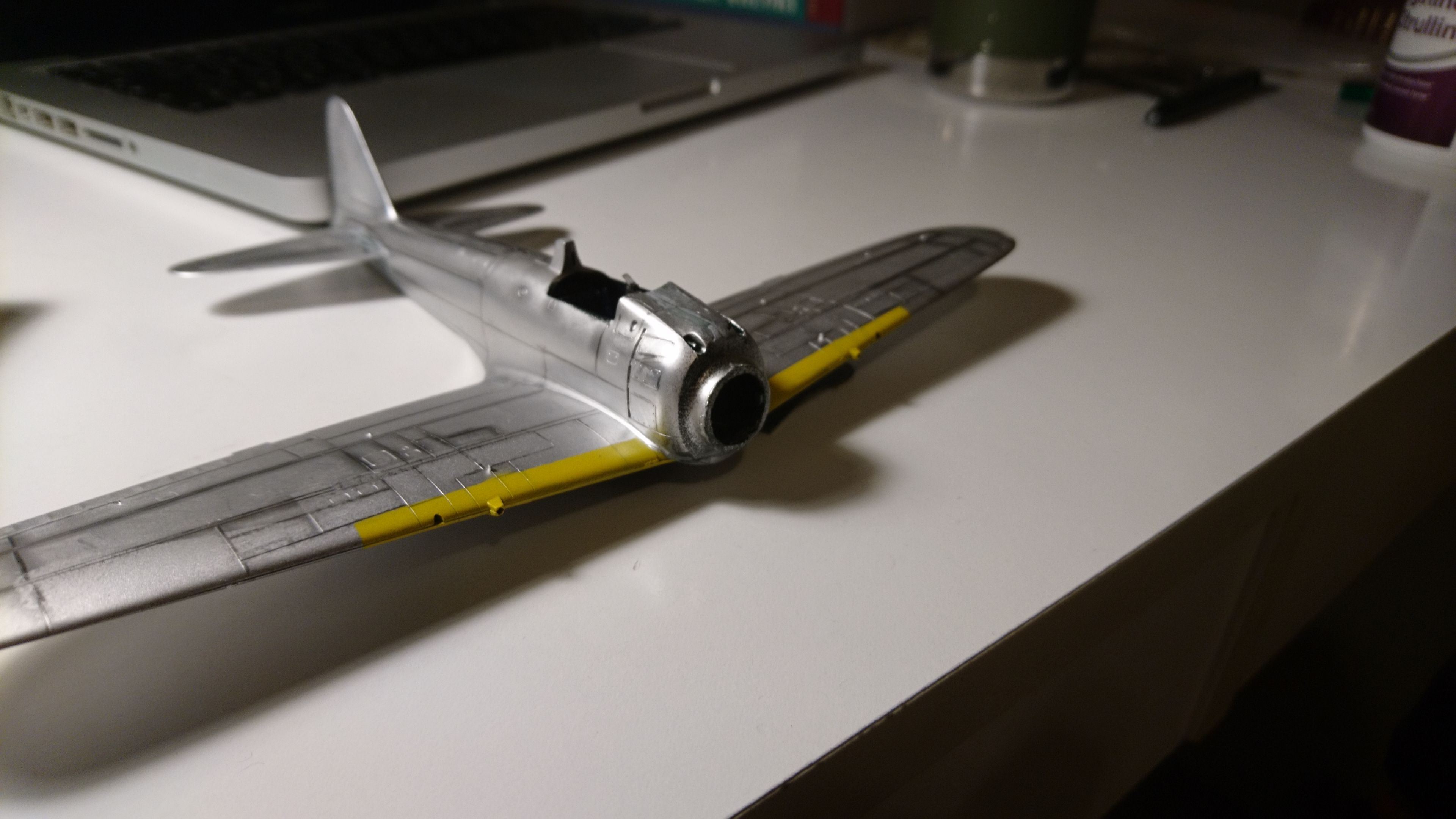
To create the chipped effect I painted the whole body in Aluminum Plate (1451 – Buffing Metalizer) from Model Master. Afterwards I scraped the paint using a toothpick. This is by far my favorite method.

After applying the metalizer, I painted the yellow stripes. Since this color was lighter than the green to be applied later, I decided to proceed in this order. I am very satisfied with the result.

I experimented by pre-shading using a 4B pencil. I do not recommend to pre-shade at this stage because the shading becomes invisible after applying the body paint.

The seatbelt was built using yellow-colored newspaper (I used the Financial Times) and painted all details using pencil.

First Published Project – A6M5c by Tamiya

This project started long ago, maybe around the year 2003. I started painting the cockpit of the beautiful Tamiya kit and left it abandoned for years. It was until winter of 2018 that I decided to finish if.

The main reason I had abandoned the project is because I did not have the skills to mask the canopy successfully. I learned to build scale models before the era of internet, therefore learning the skills back then was only by trial and error. I ruined many kits during my learning years.

Here I share the pictures of the finished model. The pictures of the entire process will be shared in another post.